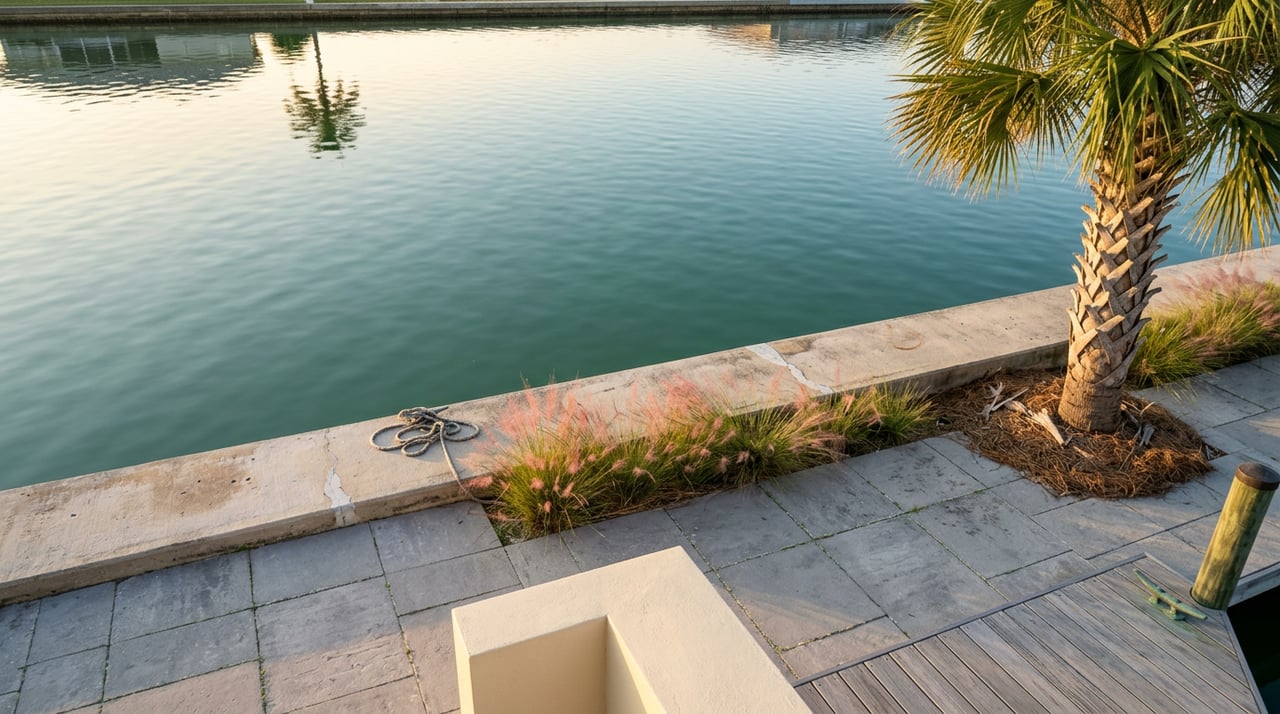
Scroll through active listings in Punta Gorda Isles and the same phrase shows up again and again: NO HOA/CDD. It reads like a clean bill of health, one less recurring cost to budget around on a waterfront purchase. And in a narrow sense, it's true. PGI has no homeowners association collecting a monthly or annual fee.
What that phrase leaves out is the line item that actually shows up every November, and it has more than doubled since Hurricane Ian made landfall in 2022.
The trade that makes PGI different from almost every other canal community on the Gulf Coast
Here's the part of the story that is genuinely true and genuinely valuable: in Punta Gorda Isles, the City of Punta Gorda owns and maintains the seawalls. Not the homeowner. Not an HOA. The city's Canal Maintenance Division inspects, repairs, and eventually replaces the roughly 91 miles of seawall that line PGI and neighboring Burnt Store Isles, along with dredging the canal system to keep it navigable for boats.
That's a real structural advantage. In most Florida canal-front markets, a failing seawall is the owner's problem and the owner's bill, and full replacement today typically runs somewhere in the range of $600 to $1,200 per linear foot depending on access, materials, and depth of the repair. On a property with 100 feet of seawall, that math gets uncomfortable fast. PGI owners don't carry that risk directly. The city does, and the city pays contractors to handle it.
But "the city pays for it" and "it's free" are not the same sentence. The city funds this work through a non-ad valorem special assessment charged separately from your regular property tax, and that assessment has been climbing every single year since the storm.
The number that tells the real story
The City of Punta Gorda publishes its Canal Maintenance Assessment rates by fiscal year, and the trend line is worth sitting with before you write an offer on a PGI address.
For a single-family parcel in the Punta Gorda Isles Canal Maintenance Assessment District, the rate moved like this:
- FY2022: $650
- FY2023: $950
- FY2024: $1,100
- FY2025: $1,200
- FY2026: $1,350
That's a jump of more than 100 percent in four budget cycles, all of it tied to the scale of repair work still underway after Hurricane Ian. And the number isn't done moving. At a July 1, 2026 council meeting, the city set a tentative rate of $1,500 per single-family parcel for the coming fiscal cycle, a $150 increase over this year's figure, with a final public hearing scheduled for September 9, 2026. Barring a change at that hearing, PGI owners are looking at an assessment that has grown roughly 130 percent since 2022.
Next door in Burnt Store Isles, which runs its own separate canal maintenance district with its own separate rate, the same climb shows up on a smaller scale: $560 in FY2022 up to $1,010 in FY2026. Same storm, same underlying cause, different math because BSI has fewer miles of seawall and canal to maintain than PGI.
None of this means the city-maintained model is a bad deal. It almost certainly still comes out ahead of paying for a full seawall replacement out of pocket. But a buyer running numbers off a listing that says "no HOA" and stops there is missing a recurring cost that shows up on the November tax bill every year, collected by the Charlotte County Tax Collector, and one that has been rising faster than most other line items on a Charlotte County property tax notice.
What the assessment covers, and where the coverage stops
The city's own guidance on seawall maintenance draws a clear line, and it's worth knowing before closing rather than after.
The assessment funds the seawall itself: inspection, structural repair, and full replacement when a panel fails. It also funds the dredging that keeps canals navigable. What it does not fund is anything attached to the wall. If your dock, boat lift, or davits sit against a seawall the city is repairing, the property owner is responsible for any damage to that equipment, not the city or its contractor. The same goes for landscaping, irrigation lines, and anything installed within six feet of the back of the seawall cap.
That distinction matters most during a transaction. If you're buying a home where the seawall shows visible wear, ask directly whether the seller has had any inspection or repair work done, and whether a dock or lift near that wall has already been budgeted for potential disruption. A typical seawall replacement project takes three to four weeks once it starts, the city gives advance notice before crews arrive, and boats have to be moved out of the work area because contractors use a barge-mounted crane to lift concrete panels weighing over two tons each. That's disruptive for a few weeks, not a dealbreaker, but it's the kind of detail worth knowing before you're the one moving the boat.
The repair list from Hurricane Ian still isn't closed
Here's the part of this story that surprises even people who've lived in Charlotte County for years: the emergency seawall repair program triggered by Hurricane Ian in 2022 is still an active, ongoing project in 2026.
A Public Works update earlier this year reported that phase one of the PGI seawall program had reached roughly 86 percent completion, with work continuing in the northwest and southwest zones. That same update noted that two barges used for the repair work suffered mechanical failures, an engine failure on one and a cable release on another, which temporarily pulled two cranes out of service and slowed progress on some lots. City staff were also revising the 2026 program work plan and waiting on formal budget rollover approval for parts of the funding.
What that means for a buyer or seller: if you're looking at a canal-front address in PGI or BSI, it is worth checking the city's own hurricane-related seawall failures page, which posts a zone-by-zone schedule covering the next six months and gets updated monthly. That page will tell you whether a specific address is already scheduled, already completed, or still waiting. Asking "is this seawall on the repair list" is not an unusual question in this market. Given where the program stands in 2026, it's a reasonable one.
What to ask before you write or accept an offer
A few questions turn this from an abstract tax-bill issue into something concrete during a real transaction:
- What is the current Canal Maintenance Assessment on this specific parcel, and has it changed in the last two years?
- Is this address, or the seawall directly adjacent to it, listed on the city's active hurricane repair schedule?
- Has the seller had any engineering assessment or repair invoice for the seawall in the last five years?
- If the seawall is scheduled for replacement, what happens to the existing dock, lift, or landscaping near it, and who bears that cost?
- How does the assessment on this parcel compare to a similar canal-front home in Burnt Store Isles, if that's part of the comparison you're making?
None of these questions are complicated to ask. They just aren't the questions most buyers think to ask when a listing description already tells them there's no HOA.
The bigger picture
Punta Gorda Isles still offers something most Florida canal communities can't: a seawall system that the city owns, inspects, and eventually replaces, which removes a genuinely large financial risk from the homeowner's side of the ledger. That's real, and it's one of the reasons PGI keeps its reputation as one of the more approachable waterfront markets in Southwest Florida.
The assessment that funds it, though, deserves the same attention buyers give to insurance premiums or flood zone designations. It's a real, rising, documented cost, and understanding where it's been and where it's likely headed is part of pricing a PGI home correctly, whether you're the one buying or the one getting ready to list.
A few questions worth asking directly
Does the canal maintenance assessment show up at closing, or only later? It's billed on the November property tax cycle through the Charlotte County Tax Collector, so it typically gets prorated at closing the same way other non-ad valorem assessments do. Ask your closing agent to confirm the current year's PGI or BSI rate is reflected correctly on the settlement statement.
If my neighbor's seawall gets replaced, does that affect my property? Not directly, but if your dock or lift shares a section of seawall with a neighboring lot scheduled for work, it's worth asking the city's Public Works Department how the project boundaries are defined before repair crews arrive.
Is Burnt Store Isles simply the cheaper option? Not necessarily. BSI's lower assessment reflects a smaller canal system with fewer miles of seawall to maintain, not a different level of protection. The right comparison depends on lot size, canal access, and how each district's five-year budget plan is trending, not just this year's number.
If you're weighing a canal-front purchase or getting ready to list in Punta Gorda Isles or Burnt Store Isles, Home Matchmaking Realty can walk through the specific assessment history and repair status for an address before you write an offer or set a price. Contact us to start that conversation.
