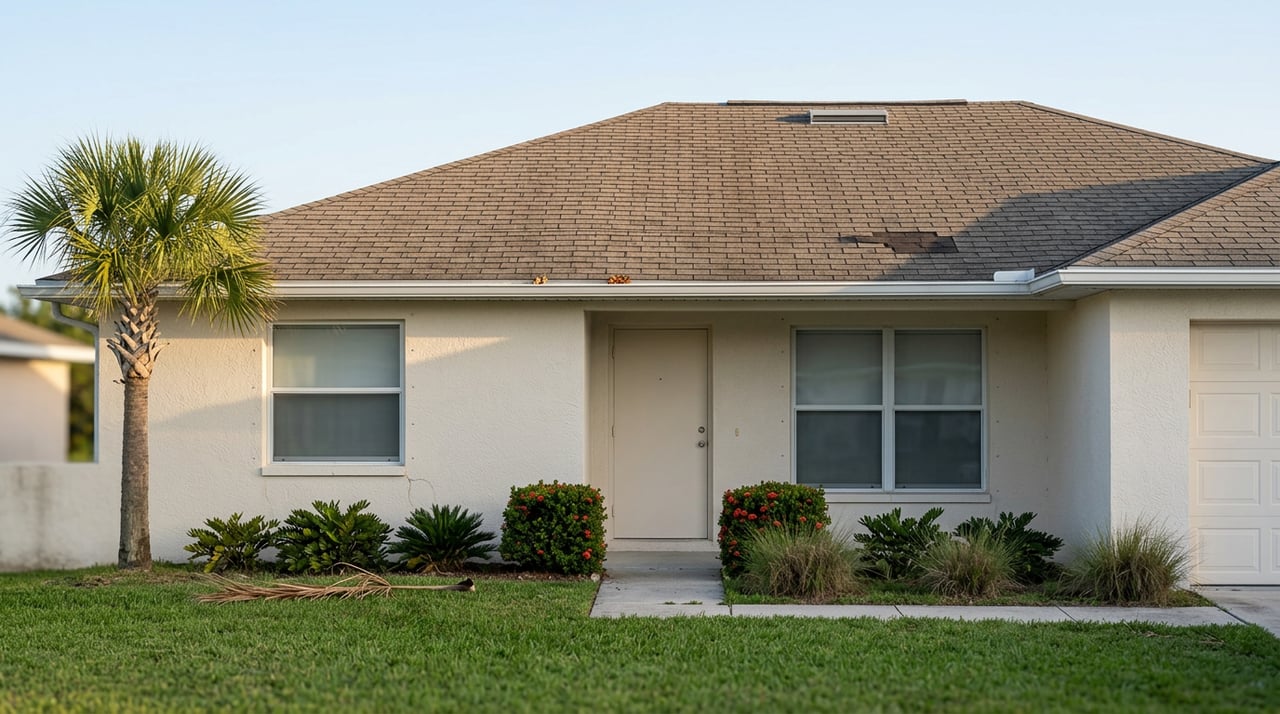
In August 2004, Hurricane Charley put a 172 mph gust through Port Charlotte, tore the roof off Fawcett Memorial Hospital, and left whole subdivisions in pieces. One house, built three years earlier to the code then in force, came through with a broken window and a few missing roof tiles. FEMA later used it as a case study: same storm, same neighborhood, wildly different outcome, and the difference wasn't luck. It was the code the home was built to.
Twenty-two years later, that same distinction is quietly deciding which Port Charlotte listings close on schedule and which ones stall in the final weeks before closing. It isn't the paint, the kitchen, or even the list price that trips people up in 2026. It's the roof's age, and what that age triggers under Florida insurance law the moment a buyer's lender asks for a binder.
The Number Buyers Skip Past Until It's Too Late
Florida Statute 627.7011 sets the line at 15 years. A roof under that age can't be denied coverage or non-renewed based on age alone. Cross 15, and an insurer can require a certified inspection proving at least five more years of useful life before it will bind or renew a policy. Most carriers treat 25 years as a practical ceiling regardless of what the certification says, and 20 years is often where asphalt shingle roofs specifically start hitting resistance.
None of this shows up on a listing photo. It shows up three weeks into a contract, when the buyer's insurance agent asks for a roof age and the seller realizes nobody has documented it since the original permit. In a market where the median Port Charlotte listing has been sitting roughly seven weeks before it even goes under contract, according to Resideline's tracked data through July 2026, a delay at the insurance stage is the kind of thing that actually kills deals rather than just annoying people.
What the Six-Month Numbers Are Really Telling You
Resideline's trailing six-month figures through July 2026 put Port Charlotte's median closed sale at $294,000, against $315,500 in neighboring Punta Gorda over the same window. The easy read is that Punta Gorda simply commands a waterfront and downtown premium. That's part of it. But it isn't the whole story, and it's not the part that matters if you're the one signing the contract.
Punta Gorda's core was substantially rebuilt after Hurricane Charley passed directly over the city in 2004, which means a meaningful share of its housing stock is newer-code by circumstance, not by luck. Port Charlotte, by contrast, was platted by General Development Corporation starting in the late 1950s, and a large share of its inventory predates the 2002 Florida Building Code entirely. That's not a knock on the neighborhood. It's the reason the roof-age conversation lands differently depending on which side of the county line you're standing on, and why a $21,500 price gap between two adjacent markets is doing more work than a scenic view.
Roof Material Sets the Insurance Clock, Not the Warranty Sticker
The number printed on a shingle bag reflects lab conditions, not Southwest Florida sun and salt air. Here's roughly how the clock actually runs for the three roof types most common in Charlotte County:
| Roof material | Typical functional lifespan here | When insurers start asking questions |
|---|---|---|
| Asphalt shingle | 15 to 20 years | Usually right at 15 years |
| Tile (barrel or flat) | Tile itself can last 50 years, but the underlayment beneath it typically fails around 20 to 25 years | When underlayment failure shows up in an inspection, regardless of how the tile looks |
| Metal (standing seam, stone-coated steel) | 25 to 30 years, with some systems rated to 50 | Rarely before 25 years if properly installed |
The tile line is the one people miss most often. A tile roof can look flawless from the driveway while the underlayment underneath it has already failed, and insurers know this well enough that a clean visual won't satisfy an underwriter who wants documented condition, not curb appeal.
The Paper Trail That Surfaces at Closing, Not at Listing
Roof age is the visible half of the problem. The other half lives in Charlotte County's permit records, and it tends to surface at title search rather than at listing.
Repairs tied to a given storm count toward something called the 50 percent rule for properties in flood hazard zones. If the cumulative value of the permits tied to that single event exceeds half the building's market value, the entire structure has to be brought up to current flood elevation requirements. Charlotte County's disaster recovery permitting guidance is explicit that this applies whether those permits are open or closed. A homeowner who pulled a roof permit and a separate electrical permit after the same storm might not realize the county adds those two together against that threshold.
Temporary housing deadlines add a real-time wrinkle worth knowing if you're evaluating a property right now. Charlotte County's emergency declarations tie RV and temporary mobile home allowances to specific windows after each storm: the Hurricane Ian window closed last September, the Idalia window closes on August 23, 2026, just one week from today, and the Helene and Milton windows run through 2027. If a property you're looking at still has an RV or temporary shelter on the lot tied to Idalia damage, that clock is almost out.
One more change lands on the same date. Starting July 1, 2026, Charlotte County recalculated how permit expiration is measured: permits issued on or after that date now expire one year after issuance or on the effective date of the next Florida Building Code update, whichever comes later. For a buyer, that means an open permit discovered during due diligence isn't automatically stale just because it's been sitting a while, and confirming its actual status matters more than assuming it lapsed.
What Actually Changed This Year, and What Didn't
Two bills, Senate Bill 808 and House Bill 815, tried to expand the 15-year roof protection to condo association and landlord policies during the 2026 legislative session and to create a separate coating-based standard for flat roofs. Both died in the Insurance and Banking Subcommittee on March 13, 2026. The upshot for Port Charlotte owners is that the current rule, the one built around the 15-year threshold and the five-year useful life certification, stays exactly as it is for at least another year. If you've heard rumors of a looser standard coming, that didn't happen.
What did change is who can perform the certification that satisfies an insurer. Since House Bill 1611 took effect in 2024, licensed roofing contractors, general and residential contractors, home inspectors, code inspectors, engineers, and architects can all issue the useful-life certification, not just engineers. That widens the field considerably for a Port Charlotte seller trying to get documentation in hand before a buyer's insurance agent starts asking questions.
And on the cost side, Citizens Property Insurance Corporation implemented a rate reduction averaging about 8.8 percent on multiperil policies and 5.5 percent on wind-only policies effective July 1, 2026, the first meaningful rollback after several years of increases. If you're currently on Citizens because a private carrier declined or non-renewed your policy over roof age, that reduction is real money, though it doesn't change whether you qualify for coverage in the first place.
A Pre-Listing Checklist Worth Running Before You Call an Agent
- Pull your roof's install date from the original or most recent re-roof permit through Charlotte County's Building Construction Services, not from memory
- If the roof is past 15 years, schedule a certified useful-life inspection before you list, not after an offer comes in
- Get a current wind mitigation inspection on form OIR-B1-1802 if you don't have one on file; it's valid for five years and can meaningfully affect what a buyer's premium looks like
- Check for any open permits tied to Ian, Idalia, Helene, or Milton repairs, and confirm whether cumulative storm-related work is approaching the 50 percent threshold for your flood zone
- If there's still an RV or temporary structure on the property tied to storm damage, confirm which storm's deadline applies and whether it's already close
A Few Questions Worth Asking Directly
Does a 15-year-old roof mean I have to replace it before selling? Not necessarily. It means an insurer can require a certified inspection showing at least five more years of useful life before binding a policy. Plenty of 15 to 20 year old roofs pass that test. The point is having the documentation ready before a buyer's insurance agent asks, not after.
What if my home has an open permit from Hurricane Ian? Confirm its status directly with the county rather than assuming it lapsed. The permit expiration rules changed on July 1, 2026, and older open permits don't automatically expire the way they might have a few years ago.
Is the roof-age rule going to change again soon? The two bills that would have expanded it died in committee in March 2026, so the current 15-year and five-year useful-life standard is the rule for at least the next year.
Port Charlotte's value case has always been real. It just runs through a different set of mechanics than a scenic view, and those mechanics are exactly where a deal can quietly come apart if nobody's paying attention until the underwriting stage. If you're weighing a sale or working through what a purchase in Charlotte County actually requires before closing, Home Matchmaking Realty works through this with buyers and sellers every day. Contact Us to talk through what your specific property and timeline actually need.
